


 Eng
Eng 
 中文简体
中文简体
 Home / News / Industry News / How to Work with Sheet Metal: Cutting, Polishing, and Producing Precision Parts?
 How to Work with Sheet Metal: Cutting, Polishing, and Producing Precision Parts?
 2026.04.16
 Industry News
Sheet Metal Fundamentals: Measuring, Marking, and Working With Precision
Precision in sheet metal work begins before any cut is made. The square is the foundational tool that determines whether every downstream operation produces accurate results or accumulates compounding errors. Knowing how to use a square on sheet metal correctly is the single most important skill for anyone producing flat pattern layouts, enclosures, brackets, or Sheet Metal Parts of any complexity. A framing square, combination square, or try square each serves a specific role, and selecting the right one for the task determines both the speed and accuracy of the layout process.
The process of using a square on sheet metal involves far more than simply placing a right-angle tool against a workpiece edge. Sheet metal surfaces are often slightly warped, have burrs along sheared edges, or carry rolled-in distortions from coil processing. Any of these surface conditions can introduce error if the square's reference edge is not placed against the cleanest, most reliable edge of the material. This is why professional sheet metal workers always establish a datum edge first, filing or grinding the reference side until a straightedge test confirms it is flat to within 0.1 millimeters across the workpiece width before any layout begins.
How to Use a Square on Sheet Metal: Step by Step
Using a square on sheet metal correctly follows a consistent sequence regardless of whether the goal is marking a single cut line or laying out a complex flat pattern for a fabricated enclosure:
- Prepare the reference edge. Use a file or deburring tool to remove any burrs or shear rollover from the edge that will seat against the square's blade or beam. A clean reference edge is essential because any gap between the edge and the square will cause angular error that multiplies across the width of the sheet.
- Select the appropriate square type. A combination square with a 300 millimeter blade is ideal for most sheet metal layout work. A framing square is better suited to large flat patterns where checking squareness across diagonal distances of 600 millimeters or more is required. A machinist's steel square is the tool of choice when tolerance requirements are tighter than 0.05 millimeters per 100 millimeters.
- Seat the stock firmly against the reference edge. Apply light, even pressure to hold the square's stock against the datum edge without lifting or rocking. Any movement of the stock during scribing will create a line that is not truly perpendicular.
- Scribe the line in a single continuous stroke. Use a carbide scriber or a sharp aluminum pencil held at a consistent 60 to 70 degree angle from vertical, tilted slightly toward the direction of travel. A single clean stroke produces a thinner, more accurate line than multiple passes.
- Verify squareness using the diagonal method. For rectangular layouts, measure both diagonals. If they are equal, the layout is square. A 1 millimeter discrepancy in diagonal measurements across a 500 millimeter rectangle indicates an angular error of approximately 0.11 degrees, which is acceptable for most structural sheet metal work but not for precision enclosures or instrumentation housings.
Common errors in sheet metal squaring include relying on the factory sheared edge as a reference (factory shear cuts are frequently 0.5 to 2 degrees off square), failing to account for the width of the scribed line when dimensioning, and using a square with a worn or damaged stock that no longer makes true right-angle contact with the blade. Investing in a certified precision square and verifying it periodically against a known reference flat ensures that the accuracy of layout work is limited by the operator's skill, not the tool's condition.
Layout Techniques for Complex Sheet Metal Parts
When producing Sheet Metal Parts that require multiple bend lines, hole patterns, and cutouts from a single flat blank, the layout sequence matters as much as the individual marking operations. Professional sheet metal fabricators establish all bend lines first, working outward from the primary datum edges, before marking any secondary features. This sequence ensures that the most dimensionally critical features, the bend allowances and bend lines, are positioned relative to the reference edges before any accumulated error from later marking steps can affect them.
Bend allowance calculation is essential for Sheet Metal Parts that must meet dimensional tolerances after forming. The standard bend allowance formula accounts for material thickness, inside bend radius, and the neutral axis factor (K-factor) for the specific material and tooling combination being used. For mild steel at 1.5 millimeters thickness with a 2 millimeter inside radius on standard V-tooling, the K-factor is typically 0.33, yielding a bend allowance of approximately 3.5 millimeters for a 90-degree bend. Marking the flat blank without accounting for this adds material to each bent flange and will cause the finished part to be oversize in every bent dimension.
How to Cut Sheet Metal Roofing Accurately and Safely
Cutting sheet metal roofing is a task that most roofing contractors and experienced DIY installers encounter regularly, yet it remains one of the operations where poor tool selection and technique cause the most problems: rough edges that void warranties, deformed profiles that create water infiltration paths, and dangerous metal shavings that accelerate corrosion wherever they land on a painted roofing surface. The correct approach to how to cut sheet metal roofing depends primarily on the roofing profile type, the cut direction relative to the panel ribs, and the coating system on the panel surface.
Choosing the Right Cutting Tool for Each Roofing Panel Type
The most commonly encountered sheet metal roofing profiles in residential and light commercial construction are corrugated, standing seam, and R-panel (or PBR panel). Each profile has characteristics that influence tool selection:
- Corrugated panels are best cut with aviation snips (compound-action tin snips) for crosscuts up to 400 millimeters wide, or with a circular saw fitted with a fine-tooth carbide blade running in reverse for long rip cuts along the panel length. Running the blade in reverse at reduced speed minimizes heat generation and protects the panel coating.
- Standing seam panels require nibblers or a dedicated metal cutting circular saw for field cuts at the ridge and eave, as snips tend to distort the panel edge and damage the seam geometry that the mechanical seamer must engage. A nibbler produces a clean kerf of approximately 3 to 4 millimeters with no heat-affected zone, preserving coating adhesion within millimeters of the cut edge.
- R-panels and trapezoidal ribbed panels are most efficiently cut with an electric shear or metal cutting jigsaw for crosscuts across the ribs, using a bi-metal blade at a slow speed to prevent chip formation. Angle grinders with cutting discs are strongly discouraged for coated roofing panels because the heat and sparks from abrasive cutting damage the zinc or paint coating over a zone of 50 to 100 millimeters from the cut, creating a corrosion initiation site.
One of the most important and often overlooked aspects of how to cut sheet metal roofing is the immediate removal of all metal filings and shavings from the panel surface after cutting. Steel filings from cutting operations that are allowed to rest on a Zincalume or Colorbond panel surface will begin to rust within 24 to 48 hours in humid conditions, and the rust staining is permanent even if the filings are subsequently removed. A leaf blower or compressed air gun used immediately after cutting prevents this problem entirely.
Cutting Techniques for Angle Cuts, Notches, and Valley Trims
Roofing installations routinely require angled cuts at hips and valleys, notches around penetrations, and mitered cuts for trim pieces at rakes and ridges. For angle cuts across corrugated or ribbed panels, the recommended approach is to mark the cut line clearly with a chalk line or marker, then use offset-blade snips (left-cut red-handled or right-cut green-handled) to work the cut progressively across the panel width, lifting the cut section clear of the blade as the cut advances to prevent the sheet from pinching the snip blades.
Notch cuts for pipe penetrations are best made by drilling a series of holes around the notch perimeter with a step drill or chassis punch, then connecting the holes with snips or a reciprocating saw with a metal blade. This method produces a cleaner notch edge than attempting to cut directly with snips, which tend to distort the metal in a cone shape around tight interior corners. Applying a cut-edge sealant rated for exterior metal roofing to all field-cut edges at penetrations is considered best practice in climates with more than 750 millimeters of annual rainfall.
How Expanded Metal Is Made: From Flat Sheet to Structural Open Mesh
Expanded metal is one of the most versatile and structurally efficient metal products in industrial fabrication, yet the process by which it is manufactured is poorly understood even among engineers who specify it regularly. Expanded metal is not woven, welded, or punched in the conventional sense; it is made by simultaneously slitting and stretching a solid metal sheet in a single continuous operation that converts flat stock into an open mesh without any material being removed or wasted. This manufacturing distinction has important consequences for the product's mechanical properties and its behavior in structural and filtration applications.
The Slitting and Stretching Process: How Expanded Metal Is Made in Detail
The production of expanded metal begins with a flat sheet or coil of metal, most commonly mild steel, stainless steel, aluminum, or titanium, fed into an expanding press. The press contains a specially profiled die set with alternating cutting and non-cutting zones arranged in offset rows. As the sheet advances through the press, the die simultaneously makes a series of short, staggered slits in the material while a lateral stretching action pulls the sheet perpendicular to the direction of travel. The combination of slitting and stretching opens each slit into a diamond-shaped aperture, and the metal between adjacent slits forms the strands and bonds of the characteristic diamond mesh pattern.
The geometry of the resulting mesh is defined by four key parameters:
- Short way of diamond (SWD): The shorter diagonal dimension of the aperture, typically 6 to 25 millimeters for standard architectural and industrial grades.
- Long way of diamond (LWD): The longer diagonal dimension, typically 1.7 to 2.5 times the SWD value.
- Strand width: The width of the metal strand forming the mesh framework, which determines load capacity and open area percentage.
- Material thickness: The thickness of the original flat sheet, which after expansion remains uniform across all strand cross-sections.
Standard expanded metal in the "raised" form retains the three-dimensional diamond geometry as it leaves the expanding press, with each strand angled relative to the original sheet plane. "Flattened" expanded metal is produced by passing the raised mesh through a secondary roller set that presses the diamonds flat, producing a sheet with a smoother surface and reduced open area percentage but improved dimensional stability and flatness for applications like walkway grating and infill panels.
Material Yield and Structural Properties of Expanded Metal
Because no material is removed during the expansion process, expanded metal achieves an open area of 40 to 85 percent while retaining a structural efficiency significantly higher than equivalent-weight perforated sheet. The geometric cold-working that occurs during strand formation increases the yield strength of the strand material by 15 to 25 percent compared to the parent sheet through strain hardening. This means that a 1.5 millimeter mild steel expanded mesh with 50 percent open area has a higher load-bearing capacity per unit weight than a 1.5 millimeter mild steel perforated sheet with 50 percent open area, making expanded metal particularly efficient for grating, safety barriers, and reinforcing applications.
The material yield advantage is also commercially significant. Because no metal is lost as scrap punchings during manufacturing, expanded metal production generates essentially zero process waste from the parent sheet material. This makes expanded metal one of the most material-efficient metal products in fabrication, a property that has gained commercial importance as raw material costs and sustainability reporting requirements have increased across manufacturing sectors.
| Expanded Metal Type | Typical SWD (mm) | Open Area (%) | Common Materials | Primary Applications |
|---|---|---|---|---|
| Raised Standard | 6 to 13 | 40 to 55 | Mild steel, stainless steel | Reinforcing, machine guards, baskets |
| Flattened Standard | 13 to 25 | 45 to 65 | Mild steel, aluminum | Walkway grating, infill panels, shelving |
| Architectural Mesh | 5 to 10 | 55 to 75 | Stainless steel, aluminum, copper | Facade cladding, balustrades, screens |
| Micro Mesh | 1 to 4 | 30 to 50 | Stainless steel, titanium | Filtration, battery electrodes, medical |
How to Polish Acrylic to a Flawless Optical Finish
Acrylic, whether in the form of cast sheet, extruded rod, or injection-molded components, can achieve a clarity and surface quality rivaling optical glass when polished correctly. The answer to how do you polish acrylic is fundamentally a sequence of progressive abrasion followed by thermal or chemical finishing, with each stage removing the scratches introduced by the previous coarser stage. Skipping stages or rushing through intermediate grits is the most common reason polishing results fall short of the mirror-like finish that acrylic is capable of achieving.
The Progressive Sanding Sequence: From Scratch Removal to Pre-Polish
The polishing sequence for acrylic begins with the coarsest grit necessary to remove the existing surface damage, then progresses through finer grits until the surface is ready for the final polishing stage. For acrylic that has been machined, saw-cut, or heavily scratched, the starting grit is typically 180 to 220. For acrylic with only minor surface scratches or hazing, starting at 400 to 600 is more efficient and reduces total processing time.
The recommended grit progression for a full polish from a sawn edge is:
- 180 grit wet or dry paper: Remove saw marks and machining tool paths. Sand in a consistent single direction. Wet sanding with water or a light cutting fluid is strongly recommended for all grits above 400 because it prevents heat buildup, which can melt or distort the acrylic surface. Acrylic softens at approximately 100 degrees Celsius, well within the range achievable by aggressive dry sanding.
- 320 grit wet sanding: Remove the 180 grit scratches. Change sanding direction by 90 degrees at each stage so that when all scratches from the previous stage are gone, it is confirmed that the previous stage's marks have been fully removed.
- 600 grit wet sanding: The surface will appear dull and uniformly hazy. This is correct and indicates the 320 grit scratches have been replaced by the finer 600 grit pattern.
- 1000 grit wet sanding: The surface begins to show the first hints of translucency in thinner sections.
- 2000 grit wet sanding: The surface appears uniformly smooth and begins to show reflectivity under a direct light source. This is the entry point for the mechanical polishing stage.
Mechanical Polishing and Flame Polishing: Achieving Optical Clarity
After completing the wet sanding sequence to 2000 grit, the acrylic surface is ready for compound polishing. A random orbital polisher or variable-speed buffer fitted with a foam cutting pad, loaded with a plastic-specific polishing compound such as Novus Plastic Polish No. 2, applied in overlapping circular passes at 1200 to 1800 RPM will remove the 2000 grit scratch pattern and develop the first stage of optical clarity. Following with Novus No. 1 or an equivalent fine finishing compound on a clean soft foam pad at 1000 RPM produces the final mirror finish.
Flame polishing is the professional method for achieving perfectly optically clear acrylic edges, particularly on cut or machined profiles where mechanical polishing with a pad is impractical. A properly tuned propane or natural gas torch with a pointed tip is passed swiftly along the acrylic edge at a distance of approximately 80 millimeters, moving at 300 to 500 millimeters per second. The heat melts the surface micro-scratches into a perfectly smooth layer approximately 0.01 to 0.02 millimeters deep. The result, when executed correctly, is an edge that is indistinguishable from the original polished surface of cast acrylic sheet.
The risk with flame polishing is overheating, which causes crazing (a network of fine internal stress cracks) that is irreversible. Crazing occurs when residual internal stresses from machining or forming are relieved too rapidly by the thermal input. Annealing the acrylic in an oven at 80 degrees Celsius for 1 hour per 10 millimeters of thickness before flame polishing dramatically reduces the risk of crazing by relieving these stresses before the high-intensity surface heating is applied.
What Is the Most Heat Resistant Metal: Comparing Refractory Metals for Extreme Temperature Applications
Tungsten is the most heat resistant metal, with the highest melting point of any pure element at 3422 degrees Celsius (6192 degrees Fahrenheit). This property makes it the material of choice for incandescent lamp filaments, arc welding electrodes, rocket nozzle inserts, and high-temperature vacuum furnace components where no other material can maintain structural integrity. However, the question of what is the most heat resistant metal in practical engineering applications is more nuanced than a melting point comparison, because usable high-temperature strength, oxidation resistance, and machinability all affect which refractory metal is most appropriate for a specific thermal environment.
The Refractory Metal Group: Properties and Practical Limits
The five principal refractory metals — tungsten, rhenium, molybdenum, tantalum, and niobium — are defined by melting points above 2000 degrees Celsius and a distinctive combination of high-temperature strength, density, and chemical inertness. Each has a specific temperature domain and application niche where it outperforms the others:
- Tungsten (W): Melting point 3422°C. Used for filaments, electrical contacts, radiation shielding, and high-temperature tooling. Its primary limitation in oxidizing atmospheres is that it begins to form volatile tungsten trioxide above 500°C, requiring protective coatings or inert atmosphere operation above that temperature.
- Rhenium (Re): Melting point 3186°C. Combined with tungsten and molybdenum to form superalloys used in jet engine combustion chambers and rocket nozzles. Rhenium additions of 25 to 26 percent in tungsten alloys nearly double the alloy's ductility at room temperature, addressing tungsten's key weakness in fabricated components.
- Molybdenum (Mo): Melting point 2623°C. The most widely used refractory metal in industrial applications due to its lower cost, better machinability, and superior thermal conductivity compared to tungsten. Used in furnace heating elements, glass melting electrodes, and as a base metal for high-temperature structural parts.
- Tantalum (Ta): Melting point 3017°C. Distinguished by exceptional corrosion resistance at elevated temperatures, particularly in strong acids. Used in chemical process equipment, capacitor electrodes, and surgical implants. Its corrosion resistance in hydrochloric and sulfuric acid environments at temperatures up to 150°C is unmatched by any other structural metal.
- Niobium (Nb): Melting point 2477°C. Used as an alloying addition in stainless steels and nickel superalloys to prevent sensitization and improve creep resistance. Pure niobium is used in superconducting applications and high-temperature aerospace structures where its superior oxidation resistance compared to molybdenum and tungsten (with appropriate coating) is advantageous.
Nickel Superalloys: The Most Heat Resistant Metals in Practical Aerospace Engineering
For the majority of high-temperature engineering applications where both heat resistance and fabricability must be balanced, nickel-based superalloys represent the most practical "most heat resistant metal" answer. Alloys such as Inconel 718, Hastelloy X, and Waspaloy maintain usable tensile and creep strength at temperatures of 800 to 1100 degrees Celsius in oxidizing atmospheres, which covers the operating environment of gas turbine hot sections, aerospace exhaust systems, and industrial furnace components where pure refractory metals are either too brittle, too expensive, or require inert atmosphere protection.
Inconel 718 retains a yield strength of approximately 620 MPa at 650°C, a temperature at which mild steel has lost over 80 percent of its room-temperature strength and is approaching its lower critical temperature. This combination of accessible machining (relative to pure refractory metals), excellent weldability, and sustained high-temperature mechanical properties has made Inconel 718 the most widely used high-temperature alloy in aerospace and power generation, accounting for approximately 35 percent of all superalloy production by weight.
| Metal | Melting Point (°C) | Max Useful Service Temp in Air (°C) | Machinability | Primary High-Temp Application |
|---|---|---|---|---|
| Tungsten | 3422 | 500 (uncoated), 1600 (inert/vacuum) | Very difficult | Lamp filaments, rocket nozzle inserts |
| Molybdenum | 2623 | 400 (uncoated), 1500 (inert) | Difficult | Furnace elements, glass electrodes |
| Tantalum | 3017 | 300 (uncoated), 1400 (inert) | Moderate | Chemical process equipment, capacitors |
| Inconel 718 | 1260 (liquidus) | 980 (in air, oxidizing) | Moderate (carbide tooling required) | Jet engine discs, exhaust systems |
| 304 Stainless Steel | 1455 | 870 (intermittent), 925 (continuous) | Good | Furnace fixtures, heat exchangers |
Sheet Metal Parts: Design Principles, Manufacturing Methods, and Quality Standards
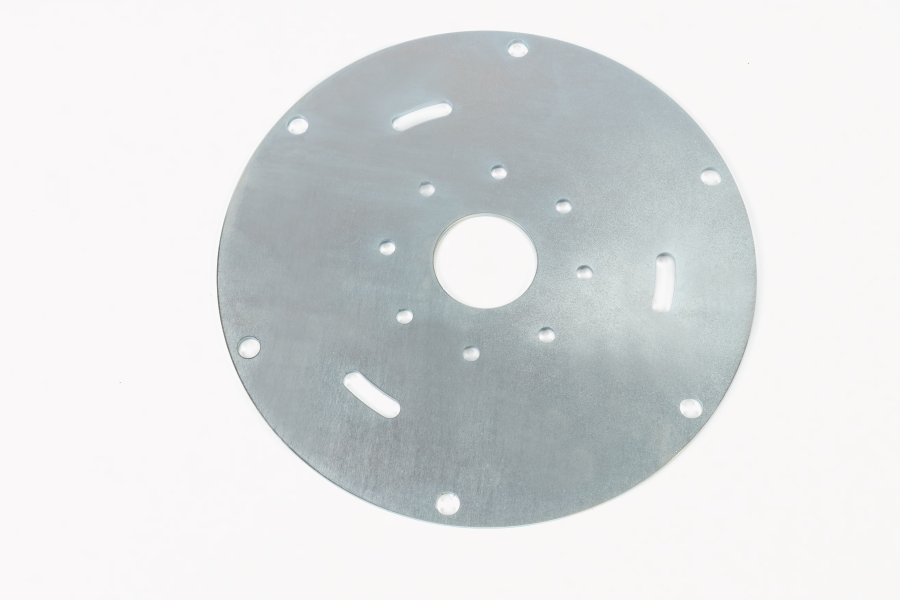
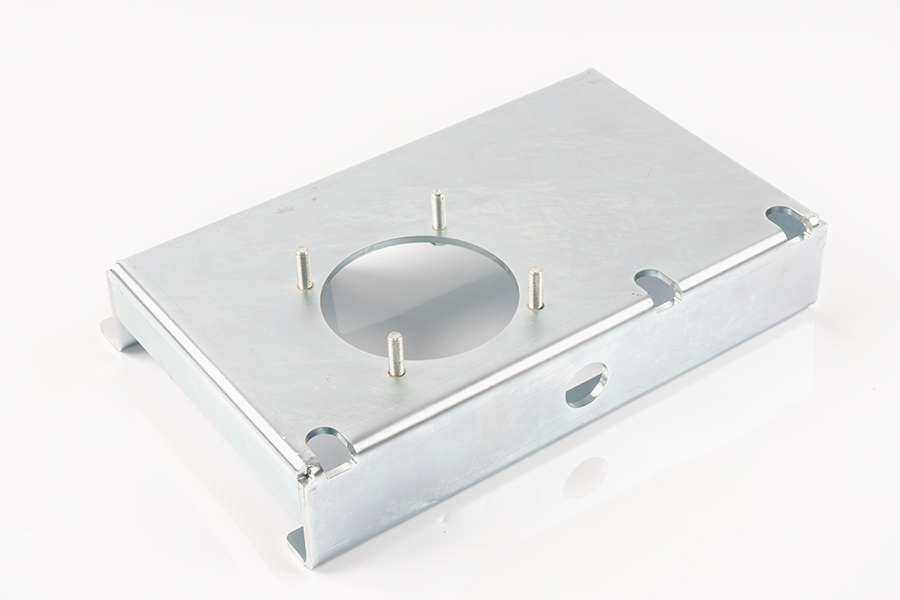
Sheet Metal Parts represent one of the broadest and most commercially significant categories in precision manufacturing. From the automotive body panels that define vehicle aerodynamics to the electronic enclosures that protect sensitive circuitry and the HVAC ductwork that moves air through commercial buildings, Sheet Metal Parts are ubiquitous in every sector of the manufactured world. The global sheet metal market was valued at approximately USD 280 billion in 2023, and Sheet Metal Parts fabrication accounts for the largest single segment of that market by both volume and value.
Design for Manufacturability: Principles That Reduce Cost in Sheet Metal Parts
The most effective cost reduction in Sheet Metal Parts occurs at the design stage, not on the production floor. Several design-for-manufacturability (DFM) principles consistently reduce fabrication cost, lead time, and rejection rates:
- Maintain consistent material thickness throughout a single part. Designing Sheet Metal Parts that can be produced from a single gauge of a single material eliminates the need for multiple nesting programs, die changes, and material handling operations. Even a 0.5 millimeter variation in specified thickness between features of the same part requires the fabricator to source, store, and process two separate material streams.
- Specify bend radii no smaller than the material thickness. The standard inside bend radius for mild steel Sheet Metal Parts is 1 times the material thickness. Specifying smaller radii requires specialized tooling, increases springback variability, and can cause micro-cracking in higher-strength materials. For stainless steel, the minimum recommended inside radius is 1.5 times material thickness due to the material's higher work hardening rate.
- Avoid very small holes relative to material thickness. The minimum recommended hole diameter for punched holes in Sheet Metal Parts is 1.2 times the material thickness. Smaller holes cause rapid tool wear and can cause the slug to be pulled back into the hole on punch withdrawal, requiring expensive secondary clearing operations.
- Locate holes and cutouts at least 2 times the material thickness from any bend line. Features positioned closer than this minimum distance to a bend line will distort during bending as the material in the bend zone strains and the feature geometry changes. This is one of the most common causes of first-article rejection in Sheet Metal Parts with complex geometry.
- Specify tolerances appropriate to the manufacturing process. Laser-cut holes in 2 millimeter mild steel can be held to plus or minus 0.1 millimeters. Bent flange dimensions can be held to plus or minus 0.3 to 0.5 millimeters with standard press brake tooling. Specifying tighter tolerances than these process capabilities requires secondary operations such as reaming, grinding, or fixture-controlled forming that dramatically increase part cost.
Surface Finishing Options for Sheet Metal Parts
The surface finish of Sheet Metal Parts affects corrosion resistance, appearance, paint adhesion, electrical conductivity, and in some applications, cleanability. The selection of surface finish is driven by the service environment, aesthetic requirements, regulatory compliance needs, and budget constraints:
- Powder coating is the most widely used finishing method for architectural and industrial Sheet Metal Parts, offering a range of textures and colors with coating thickness typically in the range of 60 to 120 micrometers. Properly applied powder coating on a phosphate-pretreated mild steel substrate provides salt spray corrosion resistance exceeding 1000 hours in ASTM B117 testing.
- Electroplating with zinc, nickel, or chrome provides both corrosion protection and a consistent metallic appearance. Zinc electroplating to a thickness of 8 to 12 micrometers is a standard finish for fasteners and structural Sheet Metal Parts used in indoor industrial environments. Hard chrome plating in the range of 25 to 75 micrometers provides wear resistance for forming tools and sliding contact surfaces.
- Anodizing is the standard finishing process for aluminum Sheet Metal Parts, building an aluminum oxide layer 10 to 25 micrometers thick that provides corrosion resistance, hardness, and a surface receptive to dye coloring. Hard anodizing to 25 to 75 micrometers provides significantly enhanced wear resistance suitable for aerospace and defense components.
- Passivation is the chemical treatment process applied to stainless steel Sheet Metal Parts to remove free iron contamination from the surface and restore the passive chromium oxide layer. Passivation per ASTM A967 or AMS 2700 is a requirement for stainless steel Sheet Metal Parts used in food processing, medical device, and pharmaceutical equipment.
Stamping Metal Parts: Processes, Tooling, and Quality Control in High-Volume Production
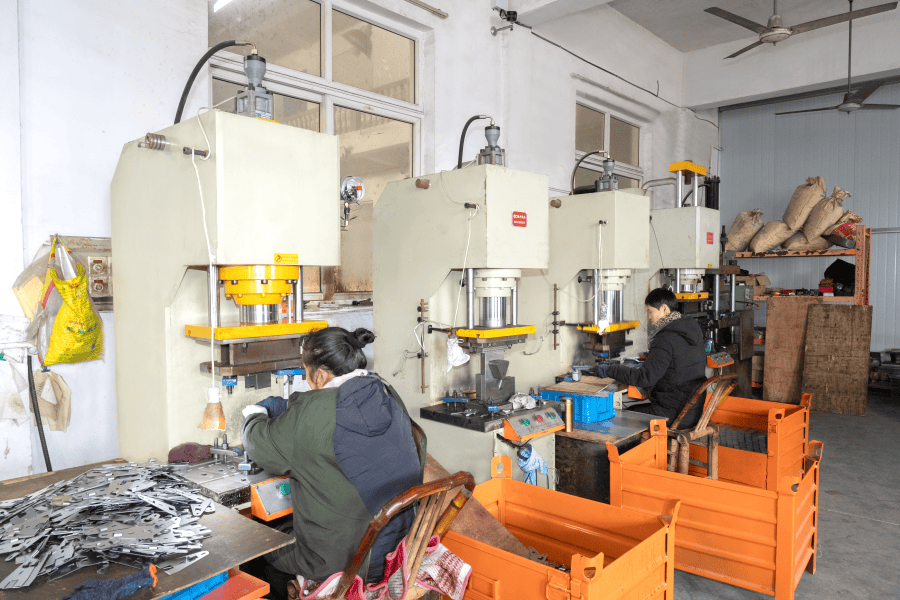
Stamping Metal Parts is the manufacturing method of choice for high-volume production of precision metal components across the automotive, electronics, appliance, and aerospace industries. Metal stamping produces parts at rates of 50 to 1500 strokes per minute depending on part complexity, die type, and press tonnage, making it the highest-throughput precision metalworking process available for flat and three-dimensional metal components. The economics of stamping are compelling at scale: tooling investment is amortized over millions of parts, and the variable cost per part drops to fractions of a cent for simple stampings produced in high-speed progressive dies.
Types of Metal Stamping Operations and Their Applications
The metal stamping process encompasses several distinct forming and cutting operations, each producing a specific type of Stamping Metal Parts feature:
- Blanking shears the outer profile of the part from the parent strip or sheet. The blank becomes the starting workpiece for subsequent forming operations. Blanking clearance between punch and die, typically 5 to 12 percent of material thickness per side, controls cut-edge quality and tool life. Insufficient clearance produces burnished cut edges with high burr formation and accelerated tooling wear.
- Piercing punches holes or internal cutouts in the workpiece. The punch diameter minus the die diameter determines the finished hole size. For Stamping Metal Parts requiring tight hole tolerances, a shave operation following the initial pierce can reduce hole diameter tolerance from plus or minus 0.05 millimeters to plus or minus 0.02 millimeters or better.
- Drawing forms a flat blank into a cup, shell, or three-dimensional hollow form by pulling the material over a punch and into a die cavity. Deep drawing of Stamping Metal Parts with draw ratios (blank diameter to punch diameter) up to 2.0 is achievable in a single draw operation with mild steel. Higher draw ratios require multiple draw stages with intermediate annealing.
- Forming and bending operations shape flat blanks into angles, channels, and complex three-dimensional profiles. Cam-driven forming in progressive dies allows Stamping Metal Parts to receive multiple bends in a single die stroke, dramatically reducing the number of press operations required compared to individual press brake operations.
- Progressive die stamping combines blanking, piercing, forming, and trimming operations in a single multi-station die through which the metal strip advances one station per press stroke. Progressive dies are the preferred tooling type for Stamping Metal Parts in volumes above approximately 100,000 pieces per year, as the elimination of material handling between operations minimizes direct labor cost and maintains part-to-part dimensional consistency.
Materials Selection for Stamping Metal Parts
The material selected for Stamping Metal Parts must balance formability (the ability to be shaped without cracking or wrinkling), strength (the mechanical properties required in service), and surface quality (the finish required for appearance and function). The most widely stamped materials, ranked by global volume, are:
- Low-carbon cold-rolled steel (LCCS): The dominant stamping material for automotive body panels, appliance components, and general industrial Stamping Metal Parts. Grades such as DC04 (DIN) or SPCE (JIS) offer n-values (strain hardening exponents) of 0.21 to 0.25, enabling deep drawing depths of 60 to 80 millimeters in a single operation for typical automotive closure panel geometries.
- High-strength low-alloy steel (HSLA): Used where Stamping Metal Parts must carry structural loads at reduced thickness compared to mild steel, reducing component weight. Yield strengths of 350 to 700 MPa are achievable with maintained formability. Springback management is more demanding with HSLA grades, requiring die compensation angles of 2 to 8 degrees beyond the target geometry.
- Aluminum alloys (3003, 5052, 6061-T4): Preferred for Stamping Metal Parts requiring weight reduction, corrosion resistance, or thermal conductivity. Aluminum stampings require press forces approximately 30 percent lower than equivalent steel stampings at the same thickness, but their lower elastic modulus produces greater springback and typically requires more aggressive die compensation.
- Stainless steel (301, 304, 316): Chosen for Stamping Metal Parts requiring corrosion resistance, hygienic surfaces, or elevated temperature service. Work hardening rates in austenitic stainless grades are significantly higher than mild steel, generating substantial press force increases during deep drawing and requiring careful lubrication management to prevent galling between the workpiece and tooling surfaces.
- Copper and brass alloys: Used for Stamping Metal Parts in electrical connectors, terminal strips, relay components, and decorative hardware. Copper's combination of excellent electrical conductivity, solderability, and deep drawing formability makes it irreplaceable in connector and terminal stampings. Brass C260 (cartridge brass) is the standard alloy for high-volume connector Stamping Metal Parts, offering a balance of formability, strength, and plating adhesion.
Quality Control and Dimensional Inspection in Stamping Metal Parts Production
Quality control in Stamping Metal Parts production operates across three temporal domains: incoming material verification, in-process monitoring, and final inspection. Each domain serves a distinct function in ensuring that the delivered parts meet dimensional, surface quality, and mechanical property specifications.
Incoming material verification for stamping stock confirms that the coil or sheet meets the specified mechanical properties, dimensional tolerances, and surface condition before it enters the production stream. Material property variation is the leading root cause of dimensional scatter in Stamping Metal Parts, because even small variations in yield strength within a coil cause proportional changes in springback behavior, shifting part dimensions outside tolerance without any change in die settings. Incoming material testing per ASTM A370 (steel) or ASTM B557 (aluminum) using tensile test specimens cut from the coil head and tail is standard practice for automotive and aerospace stamping suppliers.
In-process monitoring in high-speed progressive die operations typically relies on automated vision systems, contact probes integrated into the die itself, or downstream CMM (coordinate measuring machine) sampling at defined intervals. Statistical process control (SPC) charts tracking the key critical dimensions of Stamping Metal Parts in real time allow press operators to identify dimensional drift before parts go out of tolerance, triggering die adjustment or material change before a nonconforming batch is produced. Production facilities operating to IATF 16949 automotive quality standards are required to demonstrate process capability indices (Cpk) of 1.33 or greater on all critical dimensions of Stamping Metal Parts supplied to tier-one automotive customers, a standard that requires both excellent die design and rigorous in-process monitoring to sustain across production runs of millions of pieces.
Integrating Sheet Metal Knowledge: From Raw Material to Finished Component
The practical knowledge domains covered in this guide — from how to use a square on sheet metal, to how to cut sheet metal roofing, to how expanded metal is made, to how to polish acrylic, to what is the most heat resistant metal, and finally to the design and production of Sheet Metal Parts and Stamping Metal Parts — are not isolated subjects. They form an interconnected body of practical engineering knowledge that underpins a vast range of manufacturing and construction activities.
A fabricator producing an architectural cladding system, for example, must understand how to lay out and cut sheet metal roofing profiles with precision, how to select between mild steel and stainless or aluminum for the service environment, how the coating system interacts with cut edges, and how the formed Sheet Metal Parts will behave dimensionally through temperature cycling over their service life. A product designer creating an enclosure for an industrial heating application must understand which material represents the most heat resistant metal appropriate for the operating temperature, how to design Sheet Metal Parts features that are manufacturable within process capability, and whether the final assembly requires Stamping Metal Parts for high-volume fastener or bracket components that will be assembled with the fabricated enclosure.
The consistent thread connecting all of these domains is precision: precision in measurement, precision in cutting, precision in material selection, and precision in process control. Each operation in the sheet metal and metalworking chain has quantifiable best-practice standards, and adherence to those standards — measured in tenths of millimeters, degrees of temperature, and fractions of a percent in chemical composition — is what separates reliably high-quality production from inconsistent results that generate scrap, rework, and warranty claims.
Whether the application is a single hand-fabricated enclosure, an expanded metal architectural screen, a batch of drawn stainless Stamping Metal Parts for food processing equipment, or a structural roofing installation, the same discipline applies: know the material's properties, select the right process for the geometry and volume, set up the tools and reference surfaces correctly, and verify the results against defined quality standards. These principles remain constant across the full spectrum of sheet metal and metalworking practice, from the simplest layout operation to the most complex progressive die stamping program.

 Company Profile
 +86-189-57809418
 Zouxi Village, Tangxi Town, Yinzhou District, Ningbo City, Zhejiang Province, China
Copyright © Ningbo Mingli Electric Technology Co., Ltd. All rights reserved. Custom Hardware Parts Maunfacturers
